
20 December - Fourth Sunday of Advent – Year B
A downloadable version of this page is available for anyone who would like to save or print it out.
The Faith Action Programme would like to thank members of the Order of the Mustard Seed in Scotland for their thoughts on the fourth Sunday of Advent.
Introduction
This Weekly Worship has been brought together by members of the Order of the Mustard Seed in Scotland. The Order of the Mustard Seed is "an ecumenical, lay-led, dispersed community, inspired by the original Moravian OMS of the 18th Century". Members adopt a personal ‘Rule of Life' formed around the three principles and six practices of the OMS. Members seek to be true to Christ through living prayerfully, and celebrating creativity; to be kind to others through practising hospitality, and expressing God's mercy and justice; and to take the gospel to the nations through mission and evangelism, and learning and discipleship.
Further information about the order can be found at www.orderofthemustardseed.com
This collection of resources for the Fourth Sunday of Advent are bringing us to the final stretch of the narrative and thematic arc leading us to the celebration of the coming of Christ at Christmas. The readings and reflections circle around the idea of fulfilment, but a surprising fulfilment! In these passages we discover afresh that God's heart is to bring justice and restoration to all, beginning in the most humble and unimpressive of circumstances.
2 Samuel 7:1-11,16
David sees that the Ark of the Covenant and the presence of God still lives in a tent, even though he now lives in a house. Overwhelmed, he goes to the prophet Nathan, and the two of them seem to set plans in motion to build God a temple.
God says in response, "Who are you to build me a house? Did I ever ask you to? When I found you, you were a farm boy in a field, and I was there, and I went with you ever since, as I have been with my people, in and among them and on the move with them."
God rejects the palace, in part because it isn't all that glorious anyway: how much difference is there between a house of stone and cedar and a canvas tent to the God who made the heavens and earth? More than that, God rejects the palace in order to remain close to the community of Israel, dwelling down low among them. God, for now, is fine with canvas.
There is an echo of Advent in this moment, where Christ comes in Glory, where He dwells first in the womb of Mary and then in His own flesh and blood body, both thin and fragile and down low to the ground, in among the dirt and the people who work it. This is the persistent revelation of the Glory of God and the upside-down Kingdom which is the eschatological plan for creation. Both moments are iconoclastic – they break down our understanding of what is good and aspirational, of how we understand power and authority and the nature of who God is.
Luke 1:46b-55
This glorious passage in Luke is more commonly known, and loved, as the Magnificat, Mary's song of praise and thanksgiving. It has been described as one of the most famous songs in Christianity, and is sung or said daily around the world today as part of the liturgy of the Anglican Communion, the Catholic Church, the Eastern Orthodox Church and the Lutheran Church.
Which might lead us to wonder: why?
What are we invited to lean into as we read these words?
This song is markedly similar to the song of Hannah in 1 Samuel 2:1-10. As Tom Wright says: "Almost every word is a biblical quotation such as Mary would have known from childhood." (Luke for Everyone, SPCK Publishing).
One of the most striking features of this song is also one of the great themes of all of scripture, incomparably summarised by E Stanley Jones when he says, "the Magnificat is the most revolutionary document in the world". It might be easy to miss this powerful message in the context of two pregnant women greeting each other, and too easy to dismiss the resonance of the Magnificat with the arc of scripture – the story of a God who is always and in every way loving , faithful and just.
What kind of revolution is Mary singing about? William Barclay argues we find in the Magnificat:
- A moral revolution – "Christ enables a [person] to see themselves", and pride is confounded
- A social revolution – Christ "puts an end to the world's labels and prestige", and social constructs around worth and significance are rewritten
- An economic revolution – Christ invites us to make a society "where no person may have too much while others have too little, where every person must get only to give away", and economic measures of success are utterly upended
All of the revolutions William Barclay suggests above are irrevocably interwoven, and irrepressibly explosive. In the same way that the Magnificat bursts from Mary as a song of praise, wonder and thanksgiving, so the kingdom of God erupts into reality in the form of an infant being born into Roman-occupied Palestine, amongst the most ordinary of humans.
Once again we are reminded of the nature of our God: Divine Love, who throughout scripture demonstrates a heart for the humble, the overlooked, the poor and those who are struggling. A God of surprising reversals and revolution, who lifts up the lowly and scatters the proud – no wonder that we often talk about the ‘upside-down' kingdom of God.
Romans 16:25-27
This short hymn of praise that appears at the end of Romans is an example of a doxology, which literally means ‘words of glory'. We are familiar with using doxologies as a way of ending a prayer, a hymn, or a time of worship. They are often helpful in restating key themes and tuning them into words of praise.
The main theme of the letter to the Romans is set out in 1:16-17, where Paul describes the gospel as being the revelation of the righteousness of God. The purpose of the gospel is salvation to everyone who believes. This is why, at the end of the letter, Paul restates the gospel as the ‘revelation of the mystery that was kept secret for long ages'.
In the person of Jesus Christ, the prophecies of the Hebrew Bible have been fulfilled, but this revelation is for all nations. Paul says here that it is through the prophetic writings that this ‘mystery' has been made known to all nations.
As we approach Christmas time, we will read various Old Testament prophecies that we are used to interpreting in relation to the birth of Jesus (e.g. Isaiah 7:14, Micah 5:2, Hosea 11:1). Many of these will be read during carol services throughout this week. Sometimes we forget that these prophecies were originally written several hundred years before Jesus' birth, and that they had particular meaning for the times in which they were written. These prophecies also speak into the greater story of God's plan for salvation.
Each individual prophecy of the Old Testament is one thread in the tapestry that sets out God's salvation of the world. One side of a tapestry always looks like a mystery, but the revelation of the whole picture is very clear when seen from the other side. It was only by looking back at the prophecies in the light of Jesus Christ that these scriptures could be fully understood and the mystery made known.
The God who weaves the tapestry of salvation is all wise and all powerful. Our response to this revelation is faith, obedience and praise. Forever more the people of God offer "praise and glory and wisdom and thanks and honour and power and strength" (Revelation 7:12).
Luke 1:26-38
The events of the Annunciation were, as we've noted above, foreshadowed in the Old Testament by the building of the ark of the covenant and the temple. In some traditions Mary has for centuries been known as The Ark of the New Covenant, the dwelling place of God. Where David sought to build a dwelling place fit for the glory of God to dwell, here in Luke's account God chooses the womb of a teenage girl on the margins of an oppressed and occupied nation as the first place to dwell as the Word incarnate.
Rather than enter into exegesis, this might be a moment at which to enter into wonder. Let's imagine together for a few moments, because this is a wildly imaginative Divine expression of Love.
Christina Rossetti, in her beloved poem-hymn, evokes this wonder we can linger in:
Love came down at Christmas,
Love all lovely, Love Divine,
Love was born at Christmas,
Star and Angels gave the sign.
Worship we the Godhead,
Love Incarnate, Love Divine,
Worship we our Jesus,
But wherewith for sacred sign?
Love shall be our token,
Love be yours and love be mine,
Love to God and all men,
Love for plea and gift and sign.
Pause with these words for a while.
Imagine Mary literally embodying this profound cosmic event – Love dwelling within her body, a tender and vulnerable human vessel, preparing to bring Christ into the world.
The preciousness of her child, shared by any expectant parent, has a whole other, almost unimaginable, weight of wonder encompassing it.
This is the sweet and tender invitation of Advent: to linger in wonder at all that is waiting to be revealed to the world at Christmas.
Sermon ideas
In this last Sunday of Advent there is the opportunity in the sermon to reflect on Jesus as the eternal heir to David's throne. The promise that was made in 2 Samuel 7 is being spoken to Mary by the angel in Luke 1:32-33. You could draw on the significance of the elements that are repeated in both passages:
- He will be great (2 Samuel 7:9)
- He will be called the Son of the Most High (2 Samuel 7:14)
- He will be given the throne of David (2 Samuel 7:13)
- Of His kingdom there will be no end (2 Samuel 7:16)
David was Israel's greatest king, whose reign represented a high point in their history. David was the leader who brought unity, peace, and security, who established Jerusalem at the centre of the people's life and worship and whose psalms the people used in their prayers and their hymns. The greatness attributed to David is now being attributed to Mary's child.
Invite the congregation to think of a time in their lives or a time in history that they would consider the ‘ideal'. Is there a moment they wished would last forever? These are the emotions that are being evoked within the people of Israel when they thought about the reign of David. The promise of Mary's child is the promise of a new golden age but it is not going to be the same as what went before.
As Christmas Day approaches, you could refer to the build-up of excitement for children (and some adults) about the gifts that they are hoping for. Some of the children may have been waiting for these gifts for a long time but the day is getting ever closer. It may also be the case that some children have forgotten what they asked for by the time Christmas comes round. Nearly a thousand years have passed between the time of David and the visit of the angel to Mary. I am sure that some of the people would have forgotten about the promises in 2 Samuel 7, or perhaps no longer saw them as relevant. However, God hasn't forgotten. Part of the sermon could be about reminding the congregation of God's faithfulness across the generations.
The passage in 2 Samuel 7 is often referred to as the Davidic Covenant, and it may be an idea to approach the end of the Advent season by reflecting on the theme of covenant fulfilment. As well as being the son of David, Jesus is the greater Moses who perfectly follows the laws of God, and is the descendant of Abraham who will be a blessing to all nations. Before we go on to celebrate Christmas, you can use the sermon as a chance to pause and consider the birth of Christ in the context of God's plans to save the world that have roots in ancient promises.
Prayers
Gathering prayer/Call to worship
Lord Jesus, we pause and remember You this Advent.
The one who came down from heaven to be with us here on earth.
The one without sin who took on sin.
The one who showed love and grace in the face of rejection and even death on a cross.
Lord Jesus, have mercy upon us.
Holy Spirit of truth, come and show us afresh the love of Jesus this Advent.
As we gather to worship You,
come and have Your way.
In the mighty name of Jesus, Amen.
A prayer for at home
As you begin your worship this week, take a moment to find a candle and go somewhere where you won't be disturbed.
Put your phone away in a drawer and once you are comfortable, light your candle.
Jesus came to the world to bring light, hope and love. He is the light of the world.
Take a moment to breathe slowly and to focus on the candle. Think about the love of Jesus.
Once you are ready, pray this prayer:
Lord Jesus, light of the world, have mercy on us.
Lord Jesus, light of the world, illuminate my heart. Renew my mind afresh this day.
Lord Jesus, light of the world, bright light to the darkness in my community.
Bring hope where there is despair.
Lord Jesus, light of the world, move across our world bringing peace where there is war.
Lord Jesus, light of the world, come and be with me this day.
Show me Your glory.
Come and have Your way. Amen
Confession/Repentance
Lord God,
we admit that we have all fallen short of Your glory.
We pause now to bring to You the ways that we have sinned this week
through our thoughts, deeds and actions.
*Invitation to pause*
Lord God, we ask You to forgive us.
In this Advent season, we confess that we have become busy and distracted.
We are sorry for where we have prioritised tasks over our relationship with You.
Lord God, we ask for Your forgiveness
and we ask will You bring us back into alignment with You.
Holy Spirit, come and renew our minds and our hearts.
Lead us in the way that brings glory to You and You alone.
Come and be at the centre of our lives and our Church during this Advent season
and forever more.
Come and have Your way amongst us, here as it is in heaven.
In the mighty name of Jesus, Amen.
Thanksgiving/Gratitude
The image below can be downloaded from the link and accredited, to be displayed on a screen, or reprinted in an order of service etc. https://www.brooklynmuseum.org/en-GB/objects/4425
This beautiful small painting by James Tissot is called "Le Magnificat", depicting the moment in Luke 1 where Mary is lost in praise to God for her part in the divine plan.
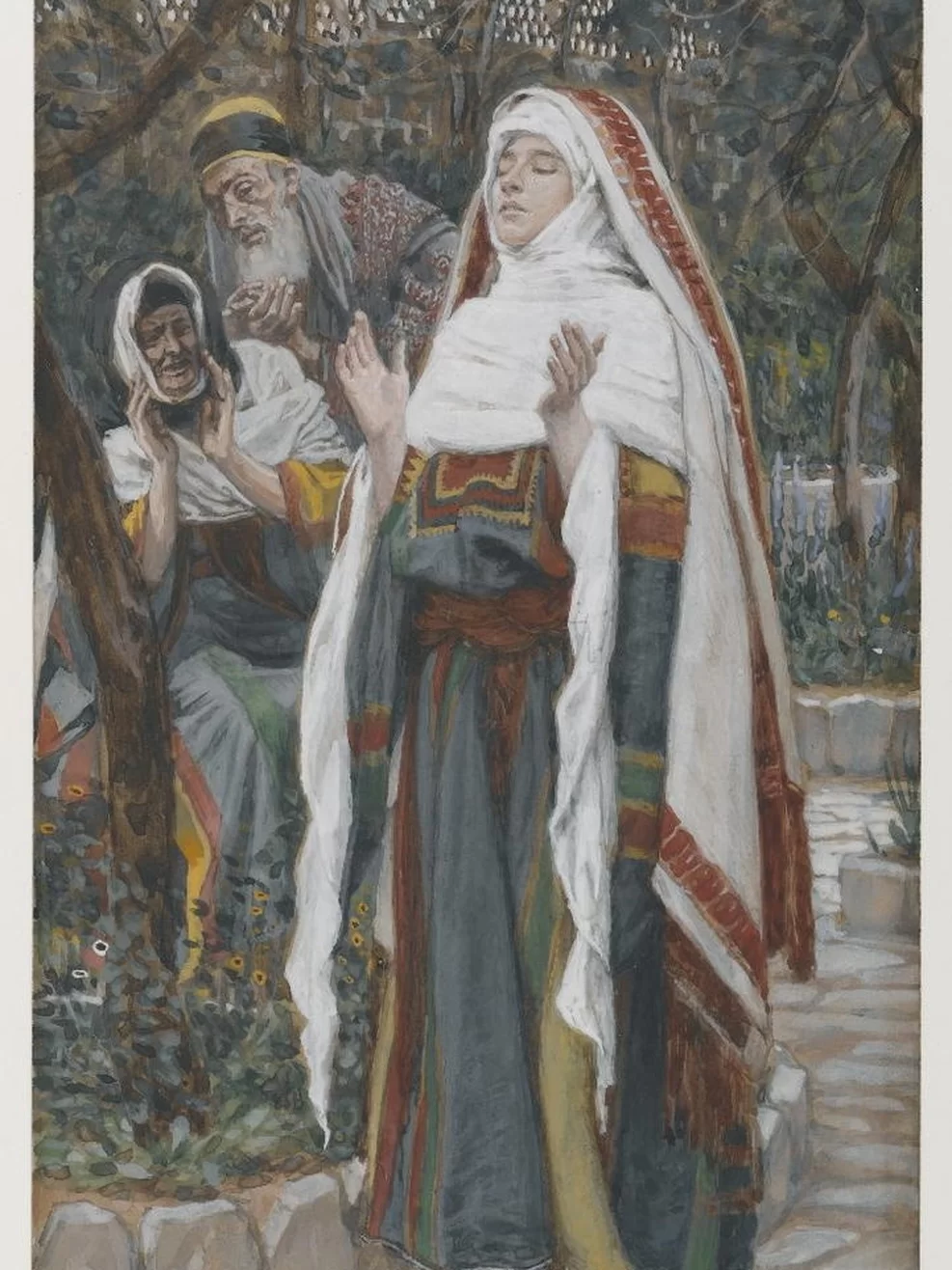
Sometimes we find a way into prayer through the use of our senses. The spiritual practice known as Visio Divina (Sacred Seeing) invites us towards more contemplative prayer. This ancient way of praying is a means of coming closer to God through our visual senses, and an open-hearted posture of receptiveness.
The ‘method of VisioDivina can be approached like this:
- Begin by allowing yourself to quieten and settle into the space you are in.
- Invite the Holy Spirit to guide your prayer.
- Now simply gaze at the image with openness and curiosity.
Allow your eyes to range over it slowly, noticing what interests you, what causes you to stop and look a little closer, what the image seems to be making you feel or think.
Are memories or connections arising?
Take your time, remembering that in this act of sacred seeing you are in the loving companionship of God.
- If you are using the image above you might like to read the Magnificat and return to this process. What does Mary's face and posture evoke in you? What else do you notice in the painting?
- Respond in your own way to God about this experience.
- You may like to join Mary in thanksgiving and wonder at the goodness of God.
Prayer for others/Intercession
Lord Jesus,
we remember Your call
to love our neighbour as ourselves.
As we reflect on this Advent season
we remember those who are struggling in our community.
Loving God,
come and be close to those who are orphaned.
Holy Spirit draw near to those who need Your peace.
Creator God, we ask will You give us eyes to see those around us.
Lord Jesus,
I ask will You help us to slow down in this busy season and to love those around us.
I ask will You come and have Your way among us.
In every household, in every neighbourhood, in every nation on this earth.
Come Lord Jesus, and have mercy upon us.
In Your mighty name we pray, Amen.
As members of the Order of The Mustard Seed we believe we are called to show kindness to those around us. As you have interceded for your neighbours, how could you show kindness to someone today? Maybe you could send a text or a letter to a neighbour, or you could donate food or your time for a local cause. It could be as simple as slowing down and taking time to be interruptible as you go about your daily routine. Ask the Lord to place on your heart someone that you could be kind to this week. If nothing comes to mind, we invite you to be kind to the next person that you meet and to show them love as we are called to in Matthew's gospel.
Blessing/closing prayer
So now, as you leave this place,
May Christ's light shine in you and through you.
May the Holy Spirit guide you.
May the love of God go with you.
In your journey,
may you find rest with God and in God.
May each of your days be filled with the presence of Jesus.
Immanuel, God with us.
Now and forever more.
In the name of the Father, the Son and the Holy Spirit.
Amen
Musical suggestions
God Welcomes All (GWA) is the new supplement to Church Hymnary Fourth Edition. This exciting new collection features over 200 hymns and songs in a wide range of styles by writers from Scotland and around the world.
The full music and words-only versions are now available; and digital resources, including the expansion of the existing Church of Scotland music website, will be published in due course, with streaming functions and further information on each song; backing tracks; and lyric videos. God Welcomes All is available to order from https://chbookshop.hymnsam.co.uk/books/9781786225573/god-welcomes-all
Our online music resource is on the Church of Scotland website; you can listen to samples of every song in the Church Hymnary 4th edition (CH4) and download a selection of recordings for use in worship. You will also find playlists for this week and liturgical seasons and themes on the Weekly Worship and Inspire Me tabs.
You can find further musical suggestions for this week in a range of styles on the Songs for Sunday blog from Trinity College Glasgow.
- A suggested playlist of songs from CH4 throughout Advent can be found on the Church of Scotland website (Advent) and in GWA 90-98
- GWA 27 – "I will always bless the Lord"
- GWA 37 – "Magnificat, Magnificat"
- GWA 94 – "Magnificat"
- GWA 224 – "Sing a new world into being"
- CH4 131 – "Salvation belongs to our God"
- CH4 286 – "Tell out my soul"
- CH4 319 – "Of the Father's love begotten"
- CH4 472 – "Come, thou long-expected Jesus"
- CH4 512 – "To God be the glory"
- MP 790 – "You are the king of glory"
- "Baby Son" – John Mark McMillian from the album Smile in the Mystery
https://www.youtube.com/watch?v=-xy6s1BSD_4
Reflecting on our worship practice
Since the start of the pandemic in 2020, the way we worship has changed and we need to reflect on the changing or newly established patterns that emerged and continue to emerge as a result of the disruption.
We can facilitate worship for all by exploring imaginative approaches to inclusion, participation and our use of technologies in ways that suit our contexts. This is not an exhaustive list, but some things we could consider are:
- Framing various parts of the worship service in accessible language to help worshippers understand the character and purpose of each part. This is essential for creating worship for all (intergenerational worship) that reflects your community of faith.
- Holding spaces for reflection and encouraging prayer to be articulated in verbal and non-verbal ways, individually and in online breakout rooms.
- In online formats the effective use of the chat function and microphone settings encourages active participation in prayer, e.g. saying the Lord's Prayer together unmuted, in a moment of ‘holy chaos'.
- While singing in our congregations is still restricted, we can worship corporately by using antiphonal psalm readings, creeds and participative prayers.
- Using music and the arts as part of the worship encourages the use of imagination in place of sung or spoken words.
- Use of silence, sensory and kinaesthetic practices allow for experience and expression beyond regular audio and visual mediums.
The following questions might help you develop a habit of reflecting on how we create and deliver content and its effectiveness and impact, and then applying what we learn to develop our practice.
- How inclusive was the worship?
Could the worship delivery and content be described as worship for all/ intergenerational?
Was it sensitive to different "Spiritual Styles"? - How was the balance between passive and active participation?
- How were people empowered to connect with or encounter God?
What helped this?
What hindered this? - How cohesive was the worship?
Did it function well as a whole?
How effective was each of the individual elements in fulfilling its purpose? - How balanced was the worship?
What themes/topics/doctrines/areas of Christian life were included? - How did the worship connect with your context/contemporary issues?
Was it relevant in the everyday lives of those attending and in the wider parish/ community?
How well did the worship connect with local and national issues?
How well did the worship connect with world events/issues? - What have I learned that can help me next time I plan and deliver worship?
Useful links
You can listen to samples of every song in the Church Hymnary 4th edition (CH4) and download a selection of recordings for use in worship in our online hymnary.
You are free to download, project, print and circulate multiple copies of any of this material for use in worship services, bible studies, parish magazines, etc., but reproduction for commercial purposes is not permitted.
Please note that the views expressed in these materials are those of the individual writer and not necessarily the official view of the Church of Scotland, which can be laid down only by the General Assembly.