
Principal Clerk leads Time for Reflection at the Scottish Parliament
Published on 10 November 2026 2 minutes read
On the eve of Armistice Day, MSPs have been called on to resist division and see the humanity in their opponents.
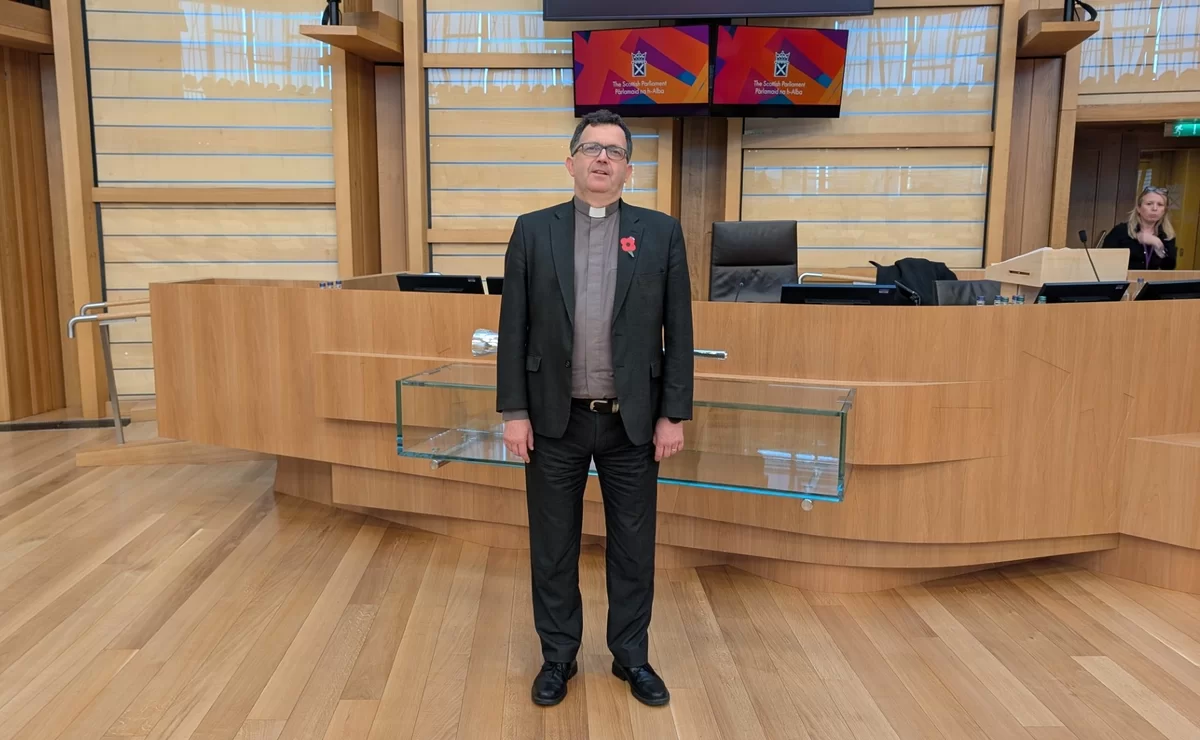
The message was delivered by Rev Dr Alistair May, Principal Clerk to the General Assembly of the Church of Scotland, who told the Scottish Parliament's regular Time for Reflection session: "To love opponents is hard.
"But Jesus tells us where to start: to pray for them is to decide to desire good things for them, for justice and peace, for healing, forgiveness or wisdom."
Dr May has previously spoken to Holyrood while parish minister of Dalziel St Andrew's Church in Motherwell, but this was his first appearance at Time For Reflection since taking up his national role in February.
He began by asking Parliament to imagine meeting a Second World War Soldier called Walter.
Walter's own father had lost an eye in the First World War, and Walter himself had been called up in 1943 and sent to the frontline as a radio operator.
Dr May continued: "A sniper on a church roof pinned down his patrol. Walter radioed for an airstrike.
"The sniper's death haunted him for years.
"In 1944, Walter became a POW, marched deep into enemy territory.
"Does Walter have your sympathy? His full name was Herr Walter Warder. A German soldier. Does that change how you hear his story?
"In Normandy, I stood among Allied graves, thankful for their sacrifice. Then, in a German cemetery: another young life beneath every stone. Another son. Another brother. Another devastated family.
"Tomorrow, we mark Armistice Day We do not celebrate. we remember. And that remembrance is as universal as is the grief of war."
Jesus commanded his disciples to love their enemies and pray for those who persecuted them, Dr May said, but this was not because the enemy was right or the persecution justified, but because we must not let division cost us our humanity.
"Division invites us to stop seeing a person and see only ‘one of them'," he continued.
"And what is true of war, is true of other arenas too: sectarian bigotry, or perhaps sometimes even the partisanship of politics."
He concluded: "Paul reminds us, that Christ loved us and died for us when we were still estranged from him. If our enemies are loved by God and valued by Christ enough to die for them. then we cannot hate, we must not dehumanise So as we remember, perhaps we also recover our humanity too.
"God of love, Grant us your love. And may we aways see each person you have created as known and loved by you as we too are known and loved In Jesus name, Amen."
Dr May's full reflection can be viewed here.