
General Assembly votes in favour of lead academic partner
Published on 17 May 2026 4 minutes read
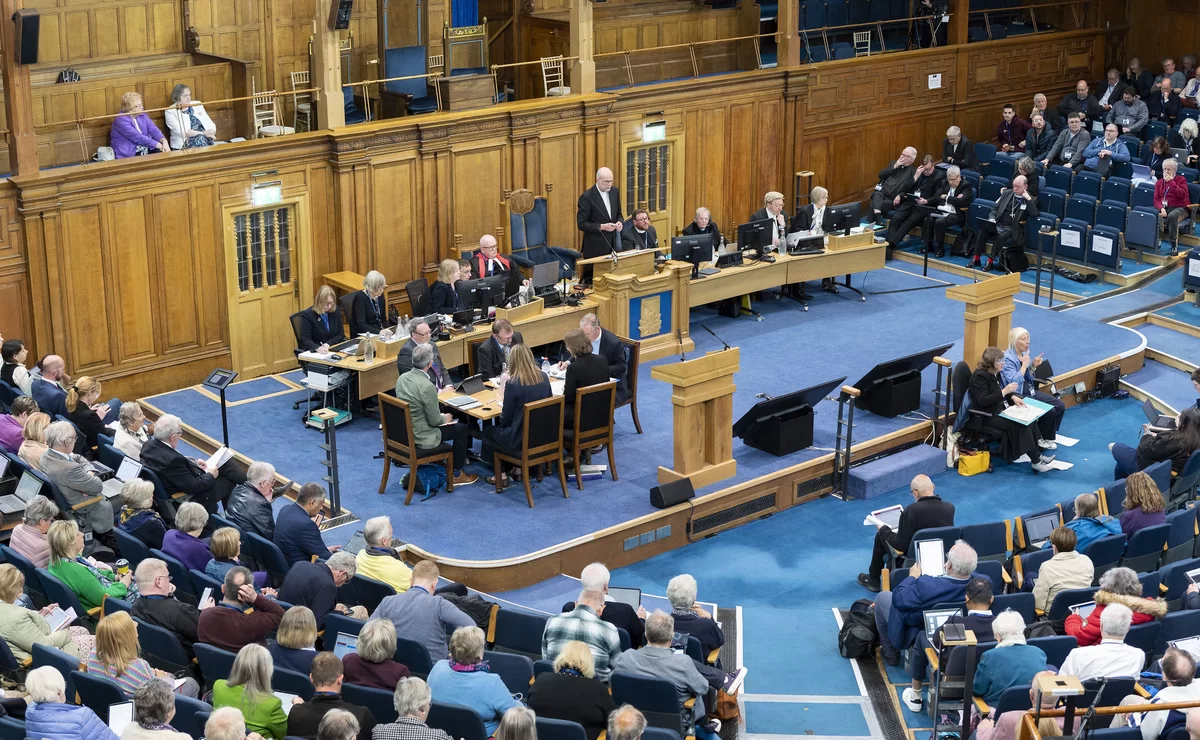
The General Assembly has voted to appoint Trinity College at the University of Glasgow as the Church of Scotland's lead academic partner for the training of national Ministers of Word and Sacrament and Deacons.
The decision marks a significant step in the Kirk's long-running efforts to reform ministerial education and create a more unified, coherent system of training across Scotland.
Under the new arrangement, a revised Initial Ministerial Education programme will begin in September 2027.
It will be delivered through a combination of in-person teaching and online distance learning (hybrid), allowing candidates from across Scotland to train without needing to relocate to Glasgow.
According to the proposal, students will follow a shared core curriculum with a stronger emphasis on transformational learning, while placements will more closely integrate practical experience, academic study and theological reflection.
Although Trinity College will take the leading role, the Church stressed that this is not a move to a sole academic provider.
Other institutions — New College at the University of Edinburgh, Christ College at the University of Aberdeen, and Highland Theological College (HTC) of the University of the Highlands and Islands — will continue to train Ordained Local Ministers, Readers and apprentices, mainly through online distance learning.
They will also continue to offer wider public-access training for the Church.
Clearer leadership
Existing candidates already studying at those institutions for national ministry or the diaconate will be able to complete their training there and will not be required to relocate. St Mary's College at the University of St Andrews did not submit a bid for the lead role and currently does not train Church of Scotland candidates.
The proposal had originally been delayed by the COVID-19 pandemic.
Church leaders emphasised that the main driver behind the reform was ministerial formation rather than financial savings.
Speaking to the Assembly, Rev Dr David Clarkson, convener of the People and Training Programme Group, described the decision as part of a process stretching back around 30 years, during which the Church has gradually moved toward context-based formation for ministry.
He said the Church had valued the contribution of all academic providers but now needed clearer leadership, deeper integration and a more coherent framework for the core task of ministerial formation.
"I want to recognise with gratitude the contribution of all our academic providers," he said.
"We have valued that contribution, and we continue to value it.
"What is proposed here is not a sole academic partner, but a lead academic partner.
"The Church will continue to work with other academic providers in different ways.
"But for the core task of ministerial formation, this report says we now need clearer leadership, deeper integration and a more coherent framework."
Countermotion
At present, there are just under 80 people in training across the Church's pathways for full-time ministry, ordained local ministry, the diaconate and readership.
Supporters of the change argued that too few students were spread across too many institutions, leading to fragmented training, no shared cohort, and no unified curriculum.
Dr Clarkson warned that without action there was a high risk of ending up with several inconsistent versions of the same training model, which the Church could not afford.
However, the proposal was not passed without lengthy debate.
Some commissioners voiced concerns about the possible impact on students such as poor internet connectivity in the Highlands and questioned whether the new system had been fully costed.
A countermotion led by Rev Dr Jock Stein proposed continuing to work in partnership with all five university providers while asking for fully costed proposals to be brought to the 2027 General Assembly.
He argued that while the lead-partner model was promising, the Church already had a workable system and might be better served by improving collaboration between existing colleges rather than concentrating leadership in one place.
Dr Clarkson responded that previous attempts to secure a joint proposal from all providers had failed to materialise.
He also rejected the idea that appointing one lead partner would weaken the Church's national reach, pointing out that candidates already train online from distant locations – people from the Scottish Borders studying at HTC - and that placements would still take place across Scotland.
The convener maintained that the proposal was not about producing one standard type of minister, but rather about creating a common foundation while still allowing pathways for different forms of ministry such as chaplaincy, pioneering ministry, youth work and academia.
He added that Trinity College had emerged as the strongest option after a two-stage selection process involving agreed criteria, written submissions, interviews, independent weighted scoring and further scrutiny.
Better model
Dr Clarkson said: "I know there are concerns — about including probation in longer initial placements, about the shorter route to ordination, and about pressure on candidates and supervisors.
"Those concerns should not be brushed aside, they must be heard and carefully managed but neither should they become a reason for standing still.
"The choice before us is not between safety and recklessness, it is between a model that has served us in the past and a model better shaped for the future.
"The core issue is not academic quality, we value the input of all the providers, and we will still continue to work with those providers."
Commissioners rejected the countermotion by 167 votes to 146, leading to the original motion being passed.