
November 2025: Very Rev Dr Iain Greenshields
The Church of Scotland's Talking Ministry monthly series shares personal stories from those serving in Christian ministry, along with resources filled with questions, prayers and reflections to help encourage reflection on how God might be calling you at this time
For November, Very Rev Dr Iain Greenshields speaks about a career which has taken him from urban parishes in Glasgow to connecting with his island roots in the Hebrides and from serving in some of Scotland's most economically challenging communities to representing the Church of Scotland at the His Majesty the King's coronation.
My ministry: Very Rev Dr Iain Greenshields, retired minister of St Margaret's Community Church, Dunfermline in Fife
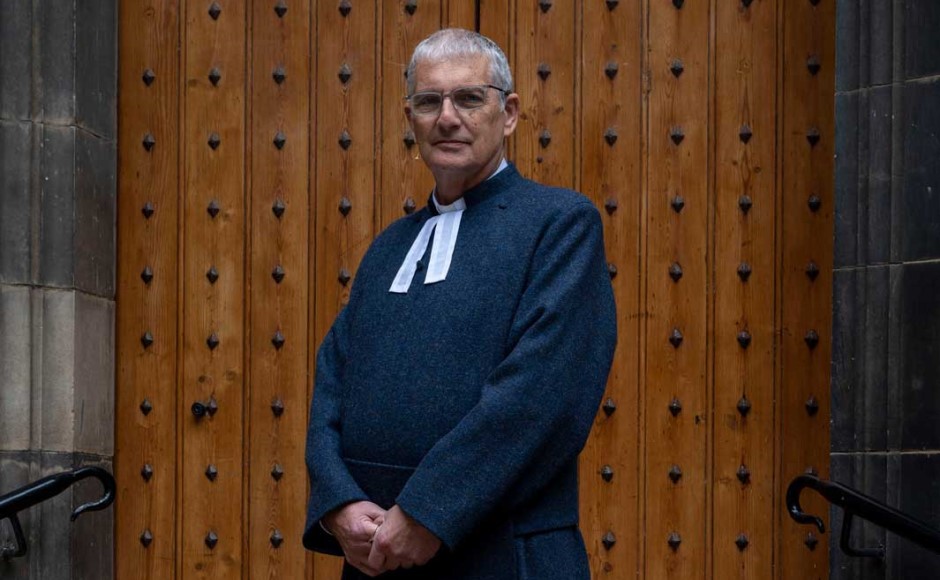
Very Rev Dr Iain Greenshields came to faith as an adult and soon after began training for the ministry. Married to Linda, who taught Religious, Moral and Philosophical Studies in a secondary school, the couple have six children, Alistair, Ross and Caitlin and Eilidh, Siona and Suisaidh. The younger three were adopted from China, which inspired Iain and Linda to found the charity Hope4China's Children, which has now raised around £1.3 million to help abandoned girls there receive an education.
When did you become a Christian?
My parents, though good Highland folk, never took my brother or myself to church, so my first real experience of church when I was in my early 20s.
I was invited to a service at Gardner Street Church in Partick and I went along, not having any expectations.
It shows my level of ignorance that after the service, I went up to the preacher and said: ‘I need to know more – where do I start?' And he said: ‘Get yourself a Bible and read it.'
So, I went out and bought myself a Bible and read it from the beginning. I got to the Book of Numbers and I went to the next Sunday service and told him that I didn't understand anything that I'd read so far. He said: ‘You need to start at the New Testament?' I said: ‘What's that?' I seriously didn't know.
That taught me a huge lesson: not to assume when you are talking to them, that you know what you are talking about. It is very easy to slip into ‘church-y' words. If you ask about my preaching, people would say that I keep it very simple. And I think Jesus was like that. He used parables to connect with people.
What prompted you to consider ministry?
I was in Ness on Lewis and I went to the Thursday night prayer meeting. Normally people would call on you to pray, and I was prepared for that, but the minister didn't ask me to pray, he asked me to preach. So, because I had been reading it, I spoke on the Book of Ephesians and afterwards, the minister said that I had to consider ministry. The minister at Gardner Street said the same, so I put in an application.
I felt really out of my depth because everyone else on the course had a strong church connection, but it was only two years since I had started going to church. But I got through it and went to university. I loved having these years of being able to immerse myself in the Christian faith because I knew so little about it.
What did your early experience of ministry teach you?
My first charge was at Cranhill in the East End of Glasgow, where I was for nine years. I had wanted to be a social worker in the East End of Glasgow and here I was, a sole minister with a parish of 13,000 in one of the most deprived parts of the city. It was a very, very challenging time. I did 110 funerals a year and that shocked me. I was not prepared for it.
Jim Aitchison, who was my supervisor during my preparatory year at Broomhill, was really good and taught me so much about what to do and what not to do in these circumstances because every year there would be murders, suicides, horrible accidents and drug deaths.

My preaching was quite evangelistic because that was the only way you could address those issues, but it was the same in the other churches in the east of Glasgow, and we all worked closely together.
It was a real deep learning experience and Linda and I both loved our time there.
But, like everything else, there comes a time when you have to move on. Out of the blue, a vacancy committee from St Machan's in Larkhall asked if they could come and listen to me.
That led to us moving from a 1970s' church into a pre-Victorian building that could hold 1,000 people. I remember someone asking what I thought of it the first time I visited and I said: ‘It's desperately dull. You have got to get these pews taken out and some life back into this.'
And that was the right thing to say.
It was a church that was wanting to modernise, but with a kirk session of 70, which made it hard to get a consensus. But we did work hard at it and made it an attractive place to come, but also created a community space because there wasn't a community facility of comparable size.
We made great friends there and still have contacts with them, and that's where our family started to come along. At one point we had three children under four and their formative years were in Larkhall.
What led you to a rural parish on Skye?
A minister on Lewis asked if I fancied going to the church at Barvas. I thought it would be nice to spend a few years there, but the same day I had a call from Portree to say a congregation in Snizort were looking for a minister and ask if I would be interested. My dad was from Skye and my mother was from Lewis, so we had connections with both islands.
Linda and I went to Lewis on a Friday night and had a long conversation with the kirk session, who decided they wanted me as minister, but I was preaching in Skye on Sunday, and the folks there said the same thing, so here we were on Monday morning with two calls.
Then the most incredible thing happened. My father had been dead for a few years by then, but my mother phoned up and said she dreamed she'd had a conversation with him. At the end of it, he said that he had to go over to Skye to see Iain. And I said: ‘Do you know where I have just been, Mum?' She said no and I just had to go and speak to Linda about that.
It became clear that we were being called there.
We were in Skye for six years. Skye was a culture shock for the children, and one we thought they would never recover from, but by the time we left, they absolutely loved it and it was good to be in touch with part of my heritage as well. It was interesting living in a culture where you have to live through a winter and had to really endure it. But the Skye people didn't give in to it. No matter how bad the weather, they just went to church or to anything else. They don't allow a little bit of adversity to stop them.
What attracted you about your final charge?
St Margaret's congregation in Dunfermline asked if we would be interested in considering a call and we eventually went down and it became apparent to us that it was the right thing to do.
I asked how many services they had on a Sunday. It was one, and I had been used to taking three services in three different locations. Down to one service on a Sunday, I couldn't believe my luck!
We couldn't have been happier in the 18 years in Dunfermline, including my Moderator's year, which was a very special year of my life.
Did your year as Moderator give you different insight to the Church?
It made me realise that there is still a deep respect in society for the Church of Scotland and what it does.
That was the case around the service of thanksgiving for the late Queen. People from other denominations and from no denomination told us that that the service in St Giles' was something so personal and different from the one in Westminster. It was the churches of Scotland gathering together with the society of Scotland to appreciate the life of The Queen and doing it within a religious context, but beautifully so.
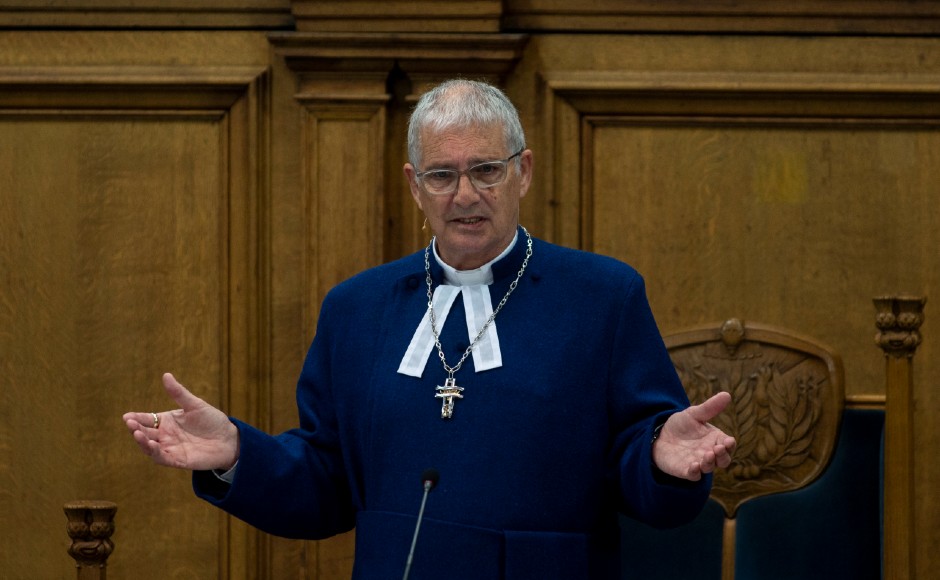
Politically, there was a warm welcome and I think it was important for the Moderator to engage with people at a level they understood. Doing your homework was very important wherever you went. Know who you are talking to, know the background of who you are talking to, know about the organisation you are visiting. That paid dividends sometimes because you could be asked to speak with no notice.
Seeing the Church on the ground in socially challenging areas – and I tried to get to as many of those as I could – you realised that the Church is more than just an arm of social work. It is a place where people go to find faith.
To some extent I think we have lost our vision in that respect, but you have other churches like St George's Tron in Glasgow. When I used to pass it on my way to work, it was closed and it's wonderful to know it is now open seven days a week now and it is there for people.
Another place that stood out for me was Croftfoot, where they had a lot of refugees on their doorstep who would come once a week and be given enough food to last them for that week. The congregation would ask what language they spoke and then would hand them information about what food they had in their own language. I thought that was an outstanding way of reaching out to people.
There were others very much like that who were making meaningful connections, often through food or clothes and providing the basics for people, or trying to reach people's deep needs and addiction needs in particular.
What impressed me more than anything was of exceptional things being done where the Church was making a difference.
But it was an outstanding year: The Coronation, the death of the Queen, joining the Pope and Archbishop of Canterbury in South Sudan. It blew my mind that I was chosen to be Moderator.
What do you love about ministry?
People. It was always people. I think one of the things that people forget is that there are folks who will come to see you on a very regular basis who maybe have no connection with the church, but whose lives are maybe deeply broken and they don't feel comfortable going to a psychologist or psychiatrist. It is those deep human contacts that I miss.
I have retired from full-time ministry, but I am preaching two or three Sundays a month and very much enjoying that. Preaching is the thing that I have enjoyed most and I am not caught up in the politics of a church's situation. It's like going back to being a student and preaching in different places.
What advice would you give to someone considering ministry?
Don't take yourself too seriously. The plaque Linda gave me 45 years ago is still here: ‘There are two foundational facts of human enlightenment. 1. There is a God, 2. You're not Him.'
You are there to serve. There is an inherent danger that ministers see themselves as leaders to the extent that they are telling people what to do all the time. There are times in a congregation's life when it needs somebody to take the bull by the horns and say: ‘We need to do this.' Other times, you have got to lead people gently.
One of the best bits of advice is to look out for the people who are doing something good and don't interfere with them.
More information
If you would like to consider how God might be calling you to serve at this time, you may want to discuss further with your minister or be in touch with your Presbytery to explore local opportunities.
If you are interested in exploring a call to the recognised ministries of the Church, you can find more information on our vocations page and can contact ministry@churchofscotland.org.uk for a Discernment Conversation with one of the Recruitment Team.